Current Residency Program
Mangará
Nydia NegromontePeriod
September 2025
Location
Campo de Ourique Studio, Lisbon
As a platform for exchange between Europe and the Global South, Verso Residency proposes a space for experimentation dedicated to practices that investigate territories and displacement, forms of coexistence, and the circulation of artistic practices.
Mangará
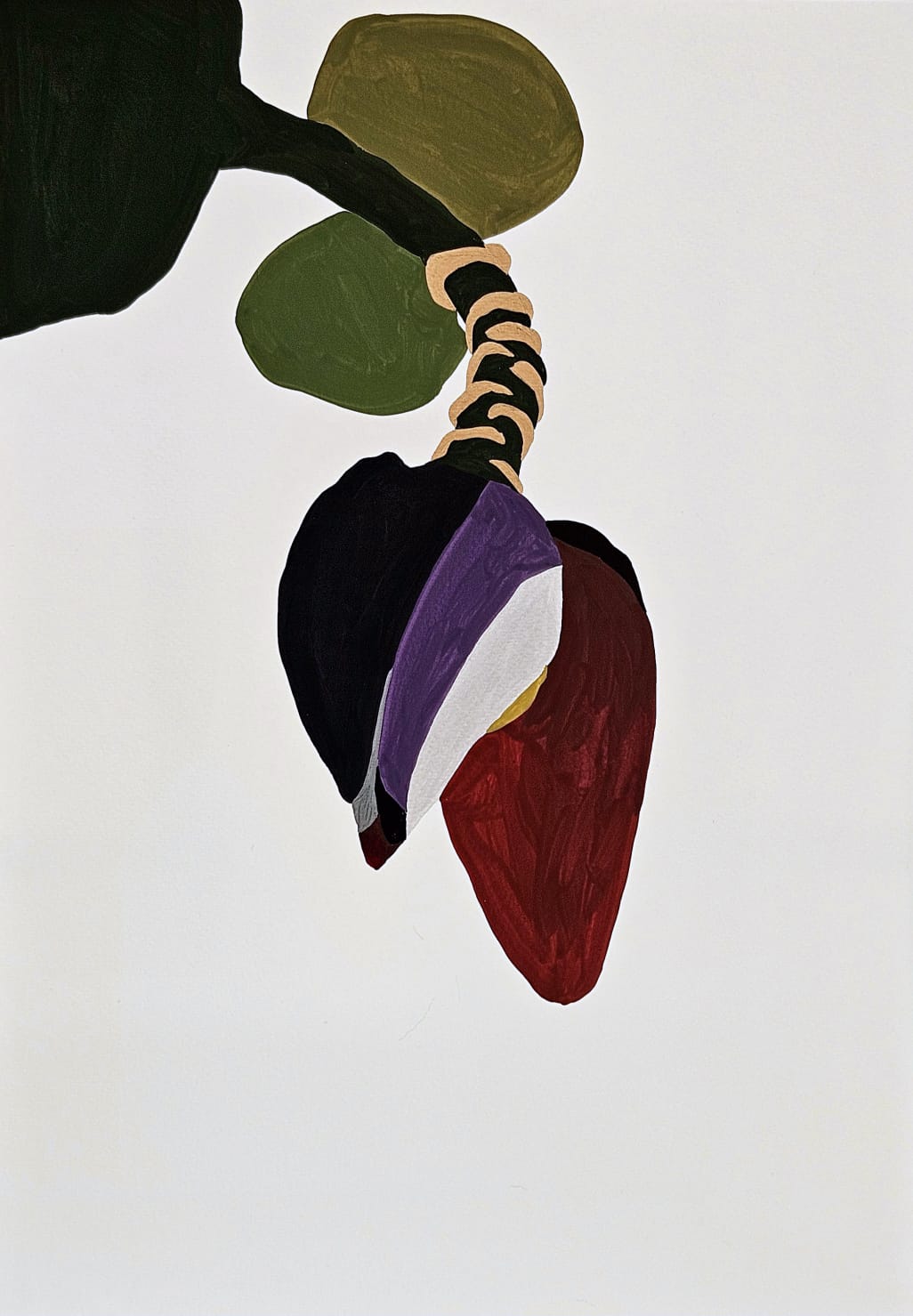
The word mangará has multiple origins: in Kimbundu, a Bantu language spoken in Angola, where mangala/mangara refers to a tree, trunk, or plant part; and in Tupi languages, where mangarã/mangará designates the spadix — a spike-like structure covered by bracts, commonly found in banana plants, pineapples, and açaí palms. In Brazilian Portuguese, these meanings converged, and mangará came to popularly refer to the heart of the banana plant.
It is at this intersection of linguistic and botanical roots that this series takes shape. Nydia Negromonte — an artist of Peruvian origin based in Belo Horizonte, Minas Gerais, Brazil — presents gouache paintings developed from recent photographic records of banana plantations in Brazil, with particular attention to the mangarás, the part of the plant where flowers and fruit are concentrated. The series unfolds from earlier investigations begun in 2016, when the artist documented a banana plantation in order to understand the pruning process known as desbaste (thinning), characterised by a genealogical structure of the fruit — grandmother, mother, and daughter. This research resulted in the exhibition Silo, presented that same year. Now, in Mangará, this interest returns to the heart of the banana plant, understood as a site of vegetal genealogies and memory.
Close observation gives rise to a practice that does not merely represent, but establishes an exercise in attention: between photographic record and painting, the gaze becomes a chromatic and formal translation, opening the way towards a language that moves away from mimesis in order to assert its own presence.
By evoking the organic structure of the reproductive organs of the banana plant, the series proposes a formal construction that is not simply an act of domination over nature, but a poetic elaboration of its continuities and unfolding forms. Within this articulation of technique and aesthetics, form and colour become fields of experimentation through which visual genealogies are developed and tensions between nature and culture are embodied.
The work is the result of two artist residencies in Lisbon — at Verso Galeria and Casa Mísia, with the support of the Kees Eijrond Foundation. At the latter, as part of the Alimento Alimenta project, Nydia Negromonte investigates urban gardens between Belo Horizonte and Lisbon, taking verbs associated with food preparation as creative tools. The research brings plants originating in the Americas — such as cassava, maize, and beans — into relation with so-called “plants in transit,” such as coffee, banana, and sugarcane, which travelled across continents and took root in new territories.
Thus, Mangará brings together geographical, cultural, and symbolic forms of displacement to consider food as an aesthetic, historical, and political practice. The heart of the banana plant, a site of vital potency, becomes here both image and metaphor for coexistence, continuity, and transformation. As in the genealogies of the banana plantation, Nydia Negromonte’s work reveals a vitality that traverses generations, territories, and languages, proposing another way of attending to nature and to the cultural networks it encompasses.